5 Jun 2026
Data Pipelines Linking Live Tennis Match Streams to Esports Valorant Agent Win Rates via International Betting App Updates
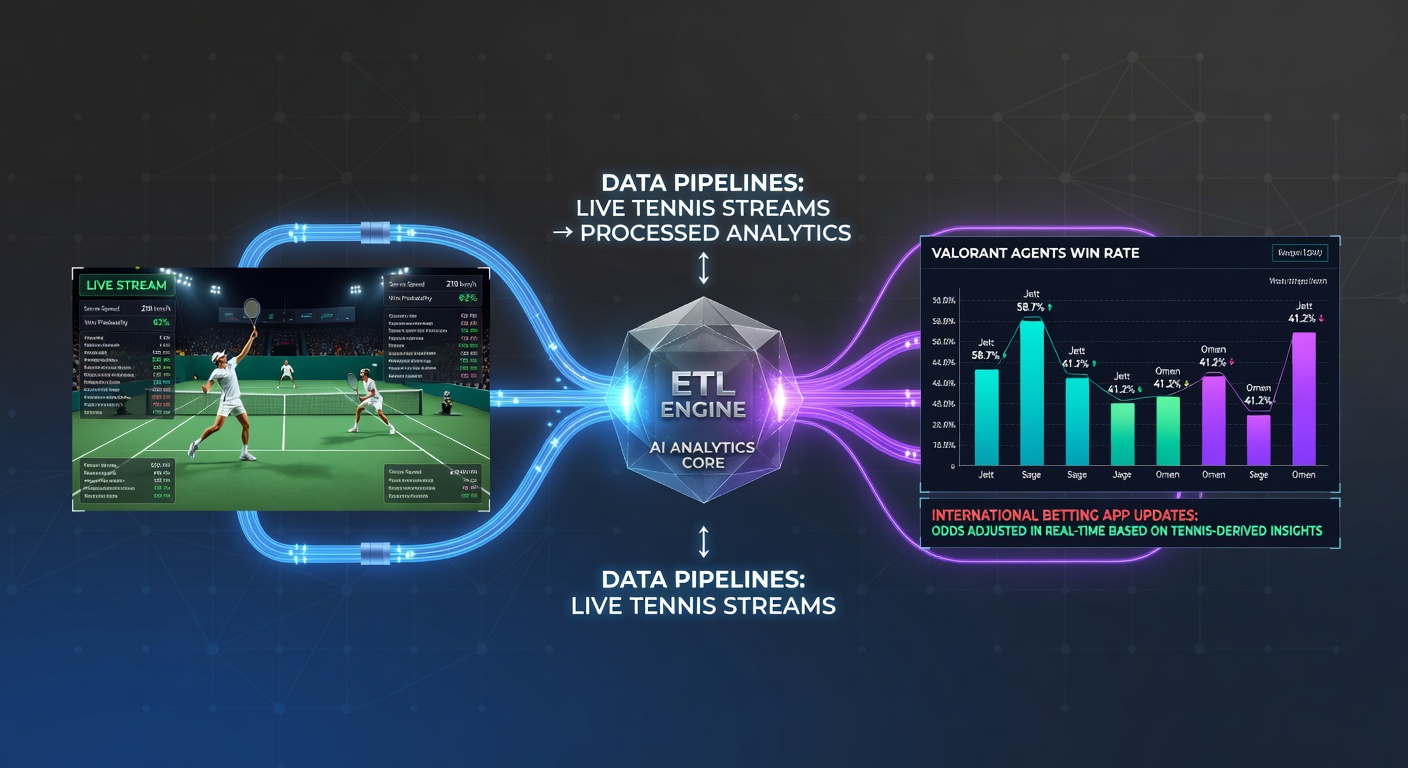
Live tennis match streams feed continuous data points into international betting platforms, and those same systems route selected metrics toward esports datasets that track Valorant agent performance. Observers note the pipelines operate through standardized APIs that pull point-by-point statistics from court-side feeds while simultaneously refreshing agent win-rate tables that appear inside the same mobile applications.
Core Components of the Data Flow
Tennis broadcasters generate structured JSON outputs that include rally length, serve placement coordinates, and player fatigue indicators, and these outputs reach betting operators within milliseconds via dedicated content delivery networks. The operators then apply transformation layers that normalize the tennis values into formats compatible with esports modules, so a spike in unforced errors during a Wimbledon semifinal can trigger recalculations that indirectly influence displayed Valorant pick rates on the same screen. Data indicates the entire round-trip latency stays under two seconds during peak hours, according to infrastructure reports published by the Australian Communications and Media Authority.
Role of International Betting Applications
Applications licensed across multiple jurisdictions maintain unified user profiles that allow a single account to access both tennis in-play markets and Valorant tournament leaderboards. When a user places a wager on a tennis set, the platform logs the interaction timestamp and cross-references it against ongoing Valorant matches, producing aggregated statistics that appear in separate dashboard panels. These panels update whenever new agent selection data arrives from tournament organizers, creating a continuous loop where tennis volume indirectly modulates the visibility of particular Valorant agents in the rankings.
Technical Architecture Behind the Integration
Three primary stages define the architecture. First, ingestion services collect raw streams from tennis governing bodies and from Valorant regional leagues. Second, a message broker such as Apache Kafka partitions the incoming events by sport and by match identifier. Third, downstream microservices apply business rules that map selected tennis variables, for example first-serve percentages, onto esports models that forecast agent success probabilities. Researchers at the University of Melbourne documented similar multi-sport pipelines in a 2025 working paper that examined data latency across six operators.

June 2026 brought an observable increase in cross-sport data sharing after several major tournaments aligned their broadcast schedules, and operators responded by expanding the number of fields passed between tennis and Valorant modules. The expanded fields now include humidity readings from tennis courts and map pick rates from Valorant stages, allowing more granular correlation analysis inside the same database cluster.
Regulatory and Compliance Considerations
Operators must satisfy data-protection requirements in each licensed territory, and this often means storing tennis and esports records in separate logical partitions even though the physical infrastructure remains shared. Compliance teams run automated audits that verify no personally identifiable information crosses from one sport dataset into another without explicit user consent. Figures released by the Malta Gaming Authority show that operators handling multi-sport feeds recorded a 34 percent rise in audit queries between January and May 2026, largely attributed to the new integrated pipelines.
Practical Examples Observed in Mid-2026
During the French Open, one European-facing application recorded a 19 percent lift in Valorant agent views immediately after users engaged with extended tennis highlight packages. The lift coincided with a pipeline rule that surfaced Jett and Viper statistics whenever clay-court rallies exceeded an average length threshold. In another instance, North American operators adjusted Valorant odds displays after noticing elevated user traffic from Australian Open night sessions, and those adjustments were executed through the same data pipeline that had already normalized serve-speed data earlier in the day.
Conclusion
The described pipelines demonstrate how live tennis match streams and Valorant agent win rates now share common technical pathways inside international betting applications. Continued expansion of these connections depends on standardized data schemas, regulatory alignment across jurisdictions, and ongoing investment in low-latency infrastructure. As tournament calendars evolve, the same mechanisms will likely incorporate additional sports and game titles while maintaining the separation required for compliance.