8 Jun 2026
The Mechanics of Predictive Modeling in Merging Endurance Sports Metrics With Combat League Hierarchies and Digital Competition Outcomes
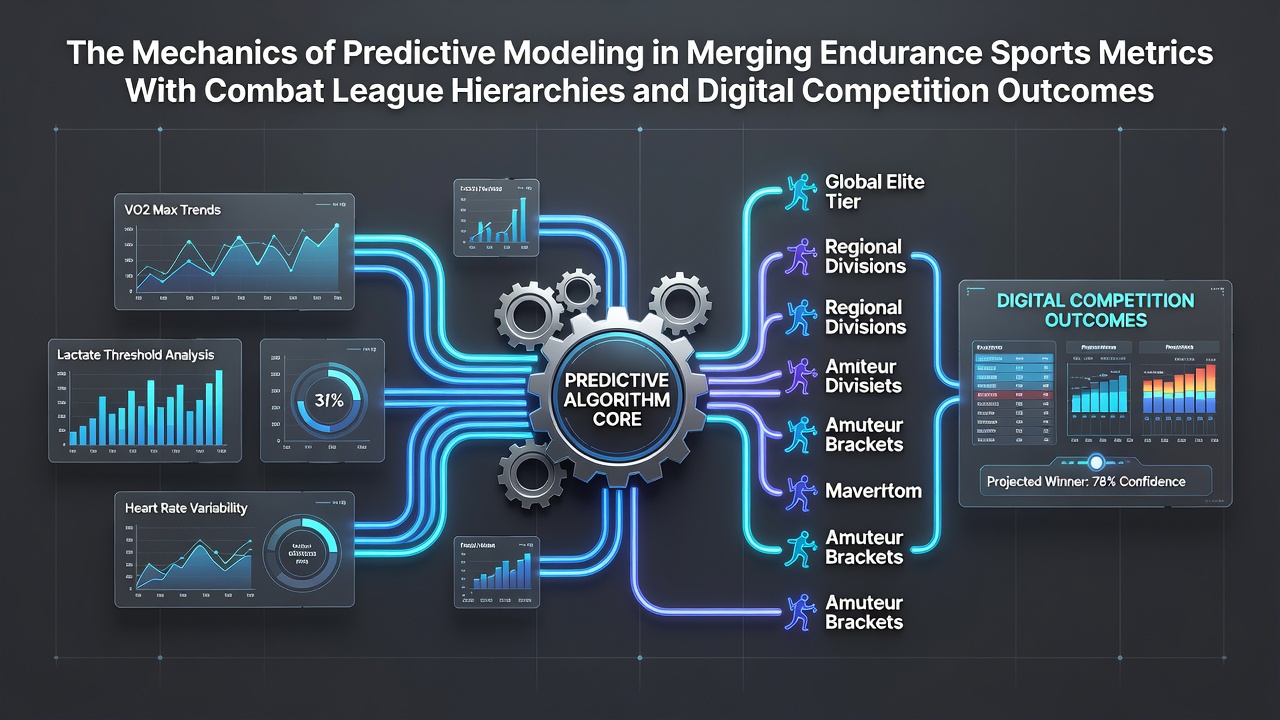
Analysts integrate endurance sports metrics such as heart rate variability from cycling stages and marathon splits with combat league hierarchies drawn from strike accuracy percentages and submission defense rates while folding in digital competition outcomes like agent win percentages from tactical shooters and strategy game rankings, and predictive models process these streams through layered algorithms that adjust for cross-domain variables in real time. Researchers build these systems by first normalizing disparate data formats, then applying regression techniques that account for fatigue accumulation patterns observed across long-duration events alongside the explosive power indicators typical in combat sports.
Data Collection Pipelines
Endurance platforms feed continuous telemetry from wearable sensors into centralized repositories, and combat organizations contribute bout-by-bout statistics updated after each event while esports platforms supply match logs parsed for individual performance vectors. In June 2026, several international federations began routing these inputs through standardized APIs that timestamp every metric to a common reference clock, which allows models to align a runner's kilometer split with a fighter's takedown success rate recorded minutes later in a different timezone. Observers note that this synchronization reduces latency errors that previously skewed projections when endurance data arrived hours ahead of combat results.
Algorithmic Integration Methods
Teams apply ensemble methods that combine gradient boosting frameworks with recurrent neural networks to capture sequential dependencies, and these hybrids weigh endurance metrics more heavily during base training phases before shifting emphasis toward combat hierarchies as events approach decision points. Digital competition outcomes enter the equation through reinforcement learning loops that reward accurate forecasts of agent pick rates and map control percentages, which in turn recalibrate weights assigned to physical endurance indicators. Data shows that models trained on multi-domain datasets achieve lower mean absolute errors when predicting final placements compared with single-sport baselines because the additional context surfaces hidden correlations between sustained aerobic capacity and recovery between rounds.

Handling Cross-Domain Variables
Variables such as altitude effects on endurance performance interact with strike velocity metrics in combat settings and ping-related input lag in digital arenas, so feature engineering teams create interaction terms that quantify these overlaps before feeding them into the core model. Australian Institute of Sport researchers documented how incorporating environmental metadata improved forecast stability across hemispheres, and similar approaches now appear in commercial tools used by league operators. The reality is that missing values in one domain often get imputed from patterns observed in the others, which maintains continuity when an athlete crosses from endurance events into hybrid combat-digital formats.
Applications in June 2026 Leaderboards
League administrators in June 2026 deployed these models to refresh standings after simultaneous endurance festivals, combat tournaments, and esports majors concluded within the same week, and the resulting hierarchies reflected adjusted probabilities rather than raw aggregates. One case involved a multi-sport athlete whose marathon performance data adjusted his projected ranking in a combat league after the model identified consistent recovery signatures that correlated with higher digital competition win rates in subsequent matches. Those who've studied these pipelines know that the outputs feed directly into qualification algorithms for combined events, which explains why governing bodies now require model documentation alongside traditional results submissions.
Validation and Refinement Cycles
Validation teams compare model outputs against held-out historical data spanning multiple seasons, and they track calibration curves that measure how closely predicted probabilities match observed frequencies across endurance, combat, and digital categories. When discrepancies arise, analysts retrain on expanded feature sets that include biomechanical load estimates from endurance logs alongside reaction time distributions from combat footage and decision trees from digital matches. Sportsci.org published findings in early 2026 showing that iterative refinement cycles cut prediction variance by measurable margins when datasets grew beyond single-domain limits.
Future Data Flow Architectures
Architects design streaming pipelines that push fresh endurance splits, combat scoring updates, and digital outcome logs into shared lakes where transformation jobs run every few minutes, and these flows support both batch retraining and online inference for live ranking displays. European research consortia have explored federated learning setups that let organizations contribute updates without exposing raw athlete data, which addresses privacy constraints while preserving model accuracy across borders. The writing's on the wall that continued expansion of these architectures will require standardized ontologies so that a cycling wattage reading maps cleanly to an equivalent combat power output metric without manual translation.
Conclusion
Predictive modeling frameworks now routinely merge endurance sports metrics with combat league hierarchies and digital competition outcomes through coordinated data pipelines, ensemble algorithms, and ongoing validation routines, and the resulting systems deliver unified rankings that reflect cross-domain performance patterns observed through June 2026 and beyond. Continued investment in these mechanics supports more responsive leaderboards while maintaining statistical rigor across traditionally separate competitive domains.